
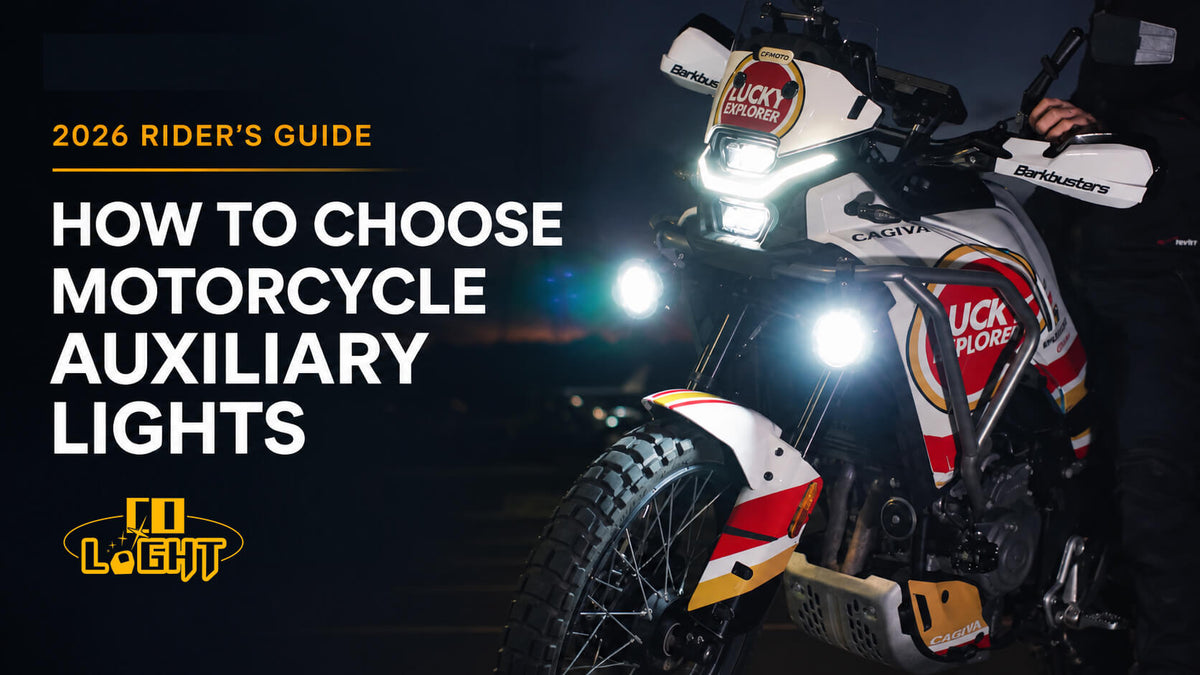
Stock motorcycle headlights are rarely built for real-world night riding. Whether you are carving down unlit B-roads in the UK, navigating misty Alpine passes in France, or crossing remote BDR trails in the American West, upgrading to dedicated motorcycle auxiliary lights is the single highest-impact visibility investment you can make. In this 2026 buyer's guide, we break down beam patterns, color temperatures, off-road and touring usage best practices (ECE vs. DOT), and exact fitment tips for top adventure and touring bikes.
1. Beam Patterns Matter More Than Raw Lumens: Cutoff vs. Spot vs. Flood
Many riders chase huge lumen numbers, only to end up with scattered glare that blinds oncoming traffic and washes out the foreground. Modern LED motorcycle driving lights rely on precision TIR (Total Internal Reflection) and Bi-LED projector optics to put usable light exactly where your eyes scan:
-
Sharp-Cutoff Low Beam (Anti-Glare Street Use): Essential for daily commuting and European roads. A horizontal cutoff keeps light below oncoming drivers' eye level. The COLIGHT Apex Series 4.5" Dual Beam Lights and compact Apex 3.5" Auxiliary Lights pair dedicated projector flood lenses with 5 TIR spot modules—delivering a razor-sharp low beam cutoff alongside a 450m–480m high beam.
-
True Bi-LED All-in-One Driving Lights: If your factory headlight feels like a candle, the NOVA Series 3" Bi-LED Driving Lights project a clean low-beam cutoff plus a 10,780-lumen focused high beam.
-
Extreme Long-Range Spot (750m Throw): For high-speed interstate miles or desert crossings where spotting wildlife early saves lives, the DB-P Series 3" Dual Beam Pods reach up to 750 meters ahead.
2. 3000K Amber Fog Lights vs. 6000K Crisp White: Choosing for Weather
Weather dictates color temperature. Crisp 6000K white light maximizes contrast and road-sign reflection on clear nights, while 3000K selective yellow/amber cuts through rain, coastal fog, snow, and trail dust with minimal backscatter.
-
Instant Dual-Color Switching: Riders tackling unpredictable mountain weather don't want to pull over to snap on lens covers. Native dual-color pods like the 3" DDF Pro Series (16,000LM) or ultra-compact 2" MT Series Mini Pods let you toggle between a 3000K yellow low beam and high-output white/combo beams right from your handlebar switch.
-
Dedicated Lower Fog Pods: Already running white driving lights? Mount a pair of 3" LA5 Amber Motorcycle Fog Lights low on your forks or engine guards to slice through dense UK winter fog and French mountain mist.
3. Sizing, Crash Bar Clamps & CANBUS Compatibility by Bike Type
Choosing the right pod diameter (2", 3", 3.5", or 4.5") keeps your cockpit balanced and avoids wiring headaches:
-
BMW R1300GS / R1250GS & CANBUS Bikes: Modern BMW GS models use sensitive CANBUS electrical systems. If you run a HEX ezCAN or Denali CANsmart controller to dim lights via your Wonder Wheel, choose the HD Series 3" Auxiliary Lights or single-color DRL D09 Pro 4.5" Lights—both integrate seamlessly. (Note: Smart-harness models like Apex and NOVA must use their included dedicated wiring harnesses).
-
Mid-Weight ADV (Yamaha Ténéré 700, Triumph Tiger 900, CFMOTO 450MT, Honda Africa Twin): A 3" or 3.5" housing like the 3.5" D03 Series with Amber Backlight delivers 7,700 lumens without overhanging crash bars during off-road tip-overs.
-
Heavy Cruisers & Touring (Harley-Davidson Road Glide, Street Glide, Pan America, Honda Gold Wing): Match big fairings with 4.5" pods like the Apex 4.5" or D09 Pro. Pro Fitment Tip: The Apex 4.5" includes standard tube clamps fitting up to 1.25" (32mm) bars—if your Harley is fitted with oversized 1.5" engine guards, we recommend choosing the D03 Series paired with the Type 2 oversized tube clamp (1.25"–2") or verifying your bar diameter before checkout.
4. Off-Road & Touring Usage Best Practices (UK, EU & US) & Pre-Ride Checklist
All COLIGHT auxiliary lights are engineered as high-output off-road and adventure lighting systems. Understanding regional equipment standards helps you get the most out of your setup wherever you ride:
-
United Kingdom & France (ECE Standards & Periodic Inspections): In the UK and France, high-output auxiliary pods are intended for off-road trails, private land, and closed-course riding, while public road lighting falls under ECE standards (and periodic checks like UK MOT or France's Contrôle Technique Moto). When riding on public highways in Europe, simply snap on the included black protective covers during the day, aim your low-beam cutoff properly, and wire your trigger to your factory high-beam circuit so auxiliary beams dip seamlessly with your main headlight.
-
United States (DOT / SAE Trail & Touring Etiquette): Across the US, riders commonly run auxiliary pods on backcountry BDR routes, rural highways, and long-distance tours. Aim beams slightly below horizontal to respect oncoming drivers, and keep strobe/warning modes strictly for trail recovery or off-road emergencies.
Ready to upgrade your night visibility? Explore our complete lineup of IP68 waterproof best auxiliary lights for adventure motorcycle & touring builds and ride with confidence after sunset.